Uncategorized

PREPTOBER 2022 | Your Morning Routine

Morning routines. They’re seen everywhere across the web. Entire YouTube channels are dedicated to perfecting the art of the morning routine. As writers, it is important that we establish a morning routine that works for our creativity rather than against it.

The 90 Minute Rule

Before you even begin planning for your morning routine, it’s important to note that every writer should begin their day with writing first thing in the morning. This is especially important during NaNoWriMo where we will all be striving to hit that 50,000 word count by the end of November. By rolling out of bed and heading straight for your computer or your notebook, you’re immediately eliminating the potential for any kind of procrastination later in the day.

I’ve read that the first 90 minutes of your day should be committed to your most important task. Your most important task during NaNoWriMo is hitting that word count. If you do not have 90 minutes at the start of your day, I recommend that you consider waking up earlier.

I’m sure some of you reading this might be groaning at that. If you’re looking for quick and easy tips and tricks to getting through NaNoWriMo, I’m telling you now: there are none. The only way out of NaNoWriMo is to push through it. And pushing through NaNoWriMo means making sure that you are up earlier than you need to be to start off your day with getting your word count done.

I plan on waking up every day at five in the morning to get my writing done so I can get in at least 90 minutes of writing in before I even begin the rest of my morning routine. I’m going into November knowing that I am going to need to sacrifice sleeping in to get my word count in. You need to go into NaNoWriMo prepared to sacrifice a bit as well.

Now, I’m not saying you need to sacrifice sleep. That is not what I am saying at all. You might need to sacrifice late night outings with your friends, but I do not recommend sacrificing your sleep to get up early. Your number one priority, above getting that word count, is making sure you get enough sleep. I’ll talk more about getting to bed at a reasonable time in an upcoming post. Just know that sleep is important for you to keep your stamina up during NaNoWriMo.

If you do have the occasional late night and need to prioritize sleeping over waking up early, then just ensure that you have at least ten minutes in the morning to keep up that habit of writing first thing in the morning. The key here is to get your momentum going first thing in the morning.

What you start your day with is going to set the tone for the rest of the day. If you start your day off by achieving your word count or making an effort to achieve your word count, then you’re automatically starting out with a win.

Remember: write first thing in the morning.

Get Moving

If you have time for it in the morning, I strongly recommend you get moving after you have written. Not only will this allow you to take your mind off of your writing, but it will help with your overall health. We all know the health benefits of exercising: lowering your resting heart rate, strengthening your muscles, helping with your digestive system––the list goes on.

But as writers, did you know that exercising can help improve your creativity? I know that when I go out on a run or hit the gym, I am way more creative and productive overall.

When I was training for my half marathons, I’d have long stretches of running where I could just think. On those long runs, I’d picture key moments of my story or how my character would feel in a certain situation. It was almost meditative for me. Please know that you do not have to train for a half marathon to get a similar result. I’m just saying that when you’re exercising, it’s easy to let your mind wander. Especially as your calves burn and you’re desperate to think about anything other than the hardest part of your workout.

Moving is also extremely important because so many of us have sedentary jobs. I sit for at least eight hours a day, working my full-time job as a social media manager. That means that I’m not moving as much as I should be on a regular basis. So I know that I need to fit in a workout at least five times a week to keep myself in shape and to help with my mental health.

If you can only carve out 20 minutes of your morning routine to workout, do it. I strongly recommend doing it right after you’ve finished writing to help you transition into the rest of your day.

Feeding Your Body and Soul

Once you’ve written and worked out, I recommend taking a few minutes to work on your spirituality. Whether that’s a meditation or opening up a prayer book, you should be focused on getting in touch with your spiritual self. If you have time to do Tony Robbins’ priming exercise, definitely do that. It’s a fifteen minute visualization that can help you hone in on your goals and gets you in touch with what you want out of life.

In addition to feeding your soul, make sure you feed your body with a healthy breakfast. Grab some protein, a fat and a carb to get your day started. I like to make myself a protein smoothie or a bagel with spinach, egg and cheese in the morning. These types of meals are quick and easy and allow me to focus on other things in the morning.

Make Yourself Presentable

For the longest time, I did not wear makeup during the day. I would wake up, shower, not dry my hair and then go to work or school in a frumpy outfit. My nails would be short and bitten down to the nubs. I would feel tired, worn down and exhausted all of the time. And you know what? I looked and felt awful.

Eventually, I read Steve Harvey’s “Act Like a Lady, Think Like a Man.” There’s a chapter in there that talks about making yourself presentable. Now, I’m not talking about dressing to the nines and wearing pinchy shoes just because they look cute. Although, if you want to do that, you’re more than welcome to. Go for it.

But just make sure that your nails are looking good. If your nail polish is chipped, take the time to either get your nails done or do them yourself. Put on clothes that make you look and feel good. Tidy up your hair and fix your makeup. Take pride in your appearance––not because you want to impress anyone, but because you love yourself enough to dress up.

Making yourself presentable is also a way to honor your writing. If you show up to write your novel in junkie sweatpants and a holed hoodie, what message are you saying to your writing? You’re telling your writing that you do not believe in it. That it is not worthy of your time to dress up for it. That it is going to be a side hustle and nothing more than a side hustle.

I’m sure we’ve all heard the saying, “Dress for the job that you want, not the job that you have.” If you dress dowdy when you write, are you really dressing for the job that you want?

Even if you’re like me and are planning on working out after you write, make sure that the sweatpants that you wear to write are nice looking. The hoodie that you wear? Not holed, that’s for sure. And your hair should be neat and tidy. And after you’re done writing and you’ve completed my workout, take a five minute shower and spend fifteen minutes putting on lotion, doing your hair, and applying makeup.

I’m worth it and so are you. So take pride in your appearance and make sure you have time in your morning routine to dress yourself up.

Plan Out Your Day

If you haven’t already planned out your day in full, I recommend planning out your day after you’ve gotten ready. It’s also a great time to check off your writing goals if you managed to write that morning. Write down your top ten goals, check of the ones that you accomplished in the morning and take a look at your day ahead.

I talked about planning out your day in an earlier post, so I won’t get too detailed here, but essentially: map out your day according to your needs and your current situation. Know where you are and where you need to be and make the appropriate changes.

Whatever your morning routine looks like, make sure that it suits your needs. Let me know in the comments section below if this was helpful and what you want your NaNoWriMo morning routine to look like.
Preptober

PREPTOBER 2022 | Planning Your Day

Starting your day without a proper plan is like flying blind without a navigation system. It doesn’t bode well.

We walked through your top ten NaNoWriMo goals in an earlier post. As a refresher, there are five categories to keep in mind when picking your top ten goals: healthsupport systemwritingaccountability, and fun. Then, you pick one or two goals for each category, adding up to a total of ten goals for your NaNoWriMo experience.

Now, you may have been thinking to yourself, Liz, ten goals is a lot. I don’t know if I have enough time in my day to get something done for each of those ten goals––let alone my actual NaNoWriMo daily word count.

But you may have more time than you realize. You just need to take a realistic look at what your time is actually going to.

Where Are You Now?

In order to achieve our goals, it’s important to have a gut check of where we are right now. Write down your current schedule on a piece of paper. Actually take your time doing this and be perfectly honest with yourself.

What does your morning look like? Are you sleeping in until nine in the morning every day? Are you waiting until the last minute to wake up for work in the morning and then scrambling to get ready?

What do your working hours look like? Are you using your break time at work to scroll through social media?

What does your afternoon look like? Do you find yourself nodding off at around three in the afternoon every day? Are you constantly reaching for coffee just to fight off exhaustion?

What does your evening look like? Do you get off of work and immediately go out for drinks with friends? Do you sit at home and watch television? How late do you stay up? Do you go to bed early or do you go to bed late?

When I asked myself these questions a few years ago, it was a hard reality check for me. The majority of my day was spent in a slump, and I honestly cannot tell you what I did during those waking hours. I can tell you that I wasn’t writing.

Where Do You Want to Be?

Now it’s time for you to figure out where you want to be. This is especially important as we go into NaNoWriMo. I want you to visualize what your ideal NaNoWriMo day will look like. Get detailed with it.

What does your morning look like? Are you waking up earlier to get your writing done? Do you workout in the morning as a part of your health goals? What do you eat in the morning to fuel your mind?

What does your work day look like? Those breaks you used to spend scrolling––are you writing instead? Are you walking for your lunch break instead of mindlessly scrolling? Do you call up one of your support system people for a quick chat?

What does your afternoon look like? Are you hydrating yourself properly so you don’t feel as tired? Are you taking a step away from work for a bit to do some meditation?

What does your evening look like? Do you call it quits for the workday at five and then go for a walk or a run before you start your evening? What time to you go to bed at night? Do you go to bed early or do you stay up a little bit later to get your writing done for the day?

Ask yourself these questions and really envision what you want your typical NaNoWriMo day to look like. Please note that every day is not going to be perfect. That’s life. Things happen. But the better we plan out our day and visualize it in full, the better we’ll handle whatever distractions life throws at us.

Routines

Over the next couple of days, I will be talking about routines in more detail, but I wanted to touch on the idea of routines in this post. We’ve all seen the epic morning and evening routines on YouTube. If you haven’t, I strongly recommend you check them out.

Writing should become a part of your daily routine. Morning, afternoon and evening routines need to involve your creativity in some way. This is particularly helpful during NaNoWriMo when we’ll all be aiming for 50,000 words in a month and we need to cram as much writing into our day as possible.

For example: I do a lot of my fantasy romance writing in the early mornings before my day gets started. In the afternoon (during my lunch break), I like to shoot videos and look at my blog. In my evenings, I write for my blog. I have it set up this way because my mornings are when my mind is freshest and I can be my most creative self. I break up my afternoon with a burst of creativity that doesn’t take too much brain power, but just enough to keep me on my toes. In the evenings, I’m ready to free write, and I view my blog almost like my diary where I can just vomit words onto a page and edit later.

Your routines may look very different from mine. Maybe you’re a night owl and find yourself way more creative at night. The bulk of your NaNoWriMo writing may need to be done at night, then. Maybe your day starts at an odd hour like ten at night because you work the night shift. Whatever your day looks like, your NaNoWriMo schedule needs to be tailored to that.

Be Realistic

Be realistic when you’re planning your ideal NaNoWriMo day. Would we all love to write for eight hours a day and achieve well over our word count on a daily basis? Yes. Is that realistic? No.

Figure out how much time you need during the day to accomplish your daily word count. You could be a writer that needs two hours just to get the typical 1667 words per day. You may not be able to carve that time out for yourself every single day and you may need to overcompensate on the weekends. Make sure you plan that out.

I recommend grabbing a planner like Angie Bellemare’s Daily Grind Planner to help you plan out your day. Her planner makes you list out your top ten goals every day and then write down your schedule so you know how you’re going to fit a task for each of your top ten goals into your day.

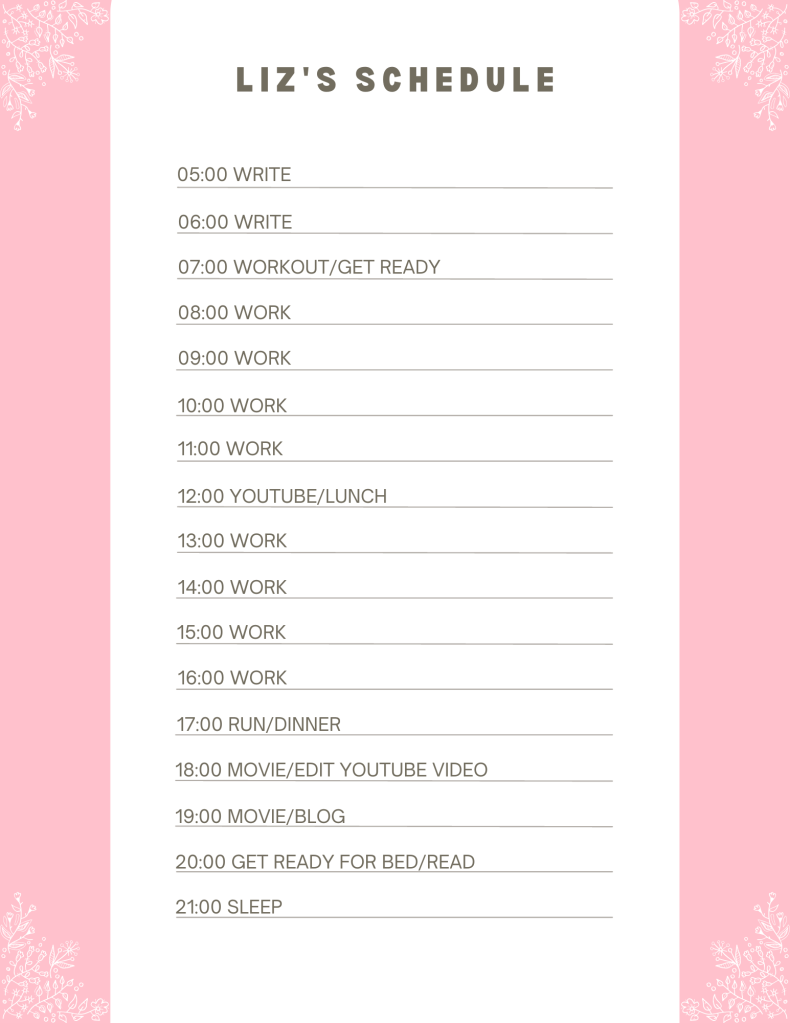
I’ll drop my ideal schedule down below so you can get an idea of what my typical day will look like in NaNoWriMo:

Notice that I incorporate my goals of fun into my schedule––I usually like to watch a movie and read in the evening. Remember to decompress after your long day and include your own fun goals into your schedule. Drop a comment below to let me know what you’re thinking in terms of your schedule and how you plan on incorporating your top ten NaNoWriMo goals into your day.

Preptober

PREPTOBER 2022 | Dream Big

We are one week away from NaNoWriMo, which means it’s time to start dreaming big. What do you want your NaNoWriMo to look like? Do you want it to be the most productive month of writing? Do you want to use it to jumpstart your next novel? Are you already working on a novel and are planning on using it to finally finish that novel?

No matter what you’re planning for NaNoWriMo, it’s time to get your creative juices flowing.

A Vision Board

Whenever I’m working on a novel, I like to create a vision board for it. You can go the old fashioned route with cut outs from magazines or you can use a tool like Canva to put your vision board together.

I recommend pulling together images that not only represent your novel through people and objects, but also other images that represent what your novel means to you. Go through Pinterest––there is a ton of inspiration there.

If you put your vision board together in Canva, you’re able to adjust the dimensions so you can turn it into your desktop background. You’re going to want your writing inspiration at your fingertips and what better way to have your inspiration at the ready than to have it as your laptop background?

Anytime you open your laptop for anything, you’re automatically flooded with images of what you want to write for NaNoWriMo.

A Playlist

I have individual playlists for each of my books that I’m thinking of. I recommend prepping two separate playlists: one should be a soundtrack playlist with songs that have words in them and one should be a score playlist with no words at all. This way, when you’re out exercising or cleaning up around the house, you can listen to your soundtrack with words for inspiration. And when you actually sit down to write, you have a score that you can have in the background that won’t distract you from getting your word count in.

Have a specific scene in mind when certain music plays? Add it to your playlist. You could even break down the playlists further by breaking up your playlists into different chapters. So chapter one would have its own playlist, chapter two would have its own playlist, and so on.

Now is the time to have fun and be creative.

Television, Movies, and Books

Now, do not use television and movies to procrastinate on your writing. This is not me telling you that you get a free pass to just watch the TV all day and skip out on your writing. This is me telling you that you should gather together some shows and movies that inspire your story.

If you’re writing horror, there are a whole bunch of Halloween movies out there for you to add to your list to watch in November. Search for what makes sense for your genre and gain inspiration from there.

If you’re a bookworm like myself, you might find that television and movies aren’t enough. Have a couple of old favorites at the ready for those evenings where you just need to relax and recharge before you have to dive back into writing again.

When dealing with entertainment, remember this: consume less than you create. So if you spend two hours in the evening watching a movie, make sure you have spent at least two hours that day writing. Remember: this is NanoWrimo and you need to complete your 50,000 word count by the end of it.

Preptober

PREPTOBER 2022 | Your Why

When I wake up in the morning and hear my alarm ringing during NanoWrimo, the first thought in my head is usually, “Why am I doing this?” And if I don’t have the answer to that question, then I am going to go right back to sleep.

Without my why, those top ten goals are not going to get accomplished during NanoWrimo. I won’t hit those 50,000 words. And I will never become a published author. Instead, I’ll pull the covers over my head and stay in bed.

Your why needs to be big. Bigger than your 50,000 word count goal in November. Your why needs to make you tremble with excitement and scare you a bit. It needs to be the one thing that is feeding those top ten goals of yours.

The question is this: why are you writing?

For Your Past Self

I started getting into writing when I was in third or fourth grade. I loved to read stories and wanted to write my own. I remember writing about princesses and dragons and reading those stories aloud by myself. I’ve always enjoyed writing––it’s a calling to me.

But that calling has been tested. A lot. I mentioned in an earlier post that I originally went to college for music education. Well, the truth is this: in high school, I had been torn between getting a music education degree or an English degree. When I talked with my parents about it, they asked the question, “Well, what are you going to do with an English degree?”

I had an answer, but my parents didn’t think it was practical: I was going to write. That’s what I was going to do with my English degree.

“You can write without an English degree,” they reasoned with me. “You can teach during the day and then write in the evening.”

What they said isn’t wrong. If you’re reading this and didn’t graduate with an English degree, you can still write. I mean, honestly, you don’t need an English degree to write. Anyone can write.

But at the time, I remember feeling like my dream was forever meant to be a side hustle. Like it wasn’t important enough to throw money behind it or give it more time than an hour or two in evenings. Like my dream didn’t matter.

I wish I had been more determined at the time to fight for an English degree. I eventually wound up graduating with an English degree, but so much less time and money would have been wasted if I had just gone with my original gut feeling.

But all of that taught me a valuable lesson: if you do not fight for your dreams, then who will? Who is going to stick up for your writing? Who is going to say, “Hey. That story you’ve been working on for years? Keep at it.”? Who is going to be in your corner every second of every day telling you that you can do this?

You are.

One of my reasons why I write is because I don’t want to let my younger self down. I don’t want to let her dreams die. I want to keep that writing dream alive and breathe life into it over and over again.

Are you writing for your past self? Your younger self that dared to dream? I recommend that you do. Don’t let your past self down.

For Your Present Self

I’m going to be honest with you: I do not like where I am in life right now. There are a couple of things about my life that I’m unhappy with.

First of all: I’m not waking up as early as I’d like to. I feel like I’m wasting time by sleeping in. Last week, I made it a goal to wake up every day around 7 AM. This week I’m aiming for 6 AM every day. The reason I’m doing this is because I am unhappy and want to change something in my life.

That change is being able to write more. Writing brings me joy. If you’re reading this blog post, then it means on some level, writing brings you joy as well. Aren’t you sick of not honoring that joy? Aren’t you sick of not carving out time of your day to express yourself freely and creatively? I know I am.

So dedicate your why to your present self, too. If you want to change and if you’re ready to become the writer you were always meant to be, focus on the joy that writing brings you. And bring that joy into your life every single day.

For Your Future Self

I met a woman the other day who is 72-years-old. It was at a fall festival in the Charlotte area where there was a Halloween costume competition and a ton of stands for local small businesses. If you’ve never done one before, I highly recommend. I was just standing in line at a food truck, waiting for my food, and this woman and I got to talking. I discovered a few things. One: she had ordered the bratwurst. Two: we were both originally from New Jersey. And three: her life wasn’t what she wanted it to be.

I couldn’t believe what I was hearing. This 72-year-old woman didn’t have her dream life. After 72 years, wouldn’t you think she has it together? But no. Her family life? In shambles. Her life’s work? Forget about it.

Imagine being that age and looking back at your life with regret. So much regret that you break down crying in a stranger’s arms not once, but three times at a fall festival.

I spent a good while just listening to her and talking with her. And as we talked, I said some things to her that I’m going to repeat to you: You are worth fighting for. No one else is going to stand up for yourself. You have done enough for other people. Stop asking for permission to do what makes you happy. Do not wait for life to begin––it’s already begun. Your time is precious and shouldn’t be wasted. Other people do not control your life––you do.

Ask yourself: where do you want to be in a year? Two years? Five? How do you want life to look in fifteen years? What do you want your life to be at 72-years-old?

The fear of looking back on my life when I’m that age and thinking, “What did I do with my life?” is absolutely terrifying to me. I do not want to be in my golden years having not accomplished my dreams. And also: not having any dreams at that age, either. I’m a dreamer. A big dreamer. And those dreams are what get me out of bed in the morning when all I want to do is hit that snooze button and go back to sleep.

Visualize your life and how you want it. If you want to be a writer like I do, then it’s time to start living like it. I really hope what I said to that woman resonated with her and that she takes my advice. And I hope that you take my advice and start living for yourself. Your past, present and future self will thank you for it.

Do what makes you happy. Figure out what your why is and begin writing. Let me know down in the comments section below if this was helpful. I love to hear from you guys.

Preptober

PREPTOBER 2022 | Your Roadblocks

Writing consistently every day for 30 days in a row can be hard. And it’s especially hard when you’re in the thick of it and have a bunch of different road blocks ahead of you. That’s why today’s post is a little different. Today’s post has a bit of tough love in it.

More often than not, during NanoWrimo we find ourselves surrounded by different excuses of why we’re not getting our writing done. Time, writer’s block, lack of inspiration, and fear are usually the main culprits that get in our way. I am familiar with all of them because I used to use them as an excuse as to why my writing wasn’t getting done.

Time

For the longest time, I used the fact that I work a full-time job as my reason why I wasn’t writing consistently. “My nine to five job was getting in the way of my dreams,” is what I told myself. That’s why I wasn’t writing as much as I would have liked.

Then throw time in for family and friends. “I can’t not have a social life,” I’d tell myself. “My friends and family need me.” There goes more time.

By the end of the day, I was too tired from all of my time being spent elsewhere that I simply couldn’t write. And so I’d say, “I’ll get to it tomorrow.” Well, tomorrow would come. And then I wouldn’t write. Again, I’d fall asleep with the promise of tomorrow in my head. “Tomorrow, I will write.”

I lived my life in an endless loop, holding out for a vision of tomorrow that never came true because I thought I didn’t have enough time. Here’s the thing, though: I had time. I was just spending it on the wrong things.

Instead of waking up early to get my writing in, I chose to sleep in until I absolutely had to get ready for work. Instead of spending my lunch breaks at work writing, I chose to scroll through social media. Instead of committing my evening to writing, I was watching television to unwind from the day. All of these things are completely reasonable to do, by the way. But they aren’t reasonable when you have a goal of writing and the spare time you do have is wasted away by other less important things.

I used time as my excuse for a while. It isn’t until I started looking at my day and actually saw what I was doing during my waking hours that I realized I had all the time I needed to accomplish my writing goals. Time was just an excuse––my lack of planning and creating time was the real problem.

Writer’s Block

If I did sit down to finally crank out some words, I’d often find myself dealing with writer’s block. “Oh, inspiration isn’t coming,” or “I’m not motivated” are phrases I used often. It was always my writer’s block that was the problem––not me.

If you’re waiting for inspiration to strike or for motivation to come, I’ve got news for you: it’s not striking and it’s not coming. The key to overcoming writer’s block is planning ahead and writing consistently every single day.

By transforming your writing into a daily habit as opposed to a spur of the moment kind of thing where you only write when you feel like it, you can easily beat out writer’s block.

Don’t get me wrong. There will be days where you maybe get a hundred words out on the page and have to step away. But that’s a hundred words that you worked hard for and pushed through for. Do not let writer’s block become an excuse to not get your writing done.

Fear of Failure

This one hits me hard. Have you ever tried something and failed? I have.

When I was in college, I thought I wanted to be a music teacher. I went to my classes and found myself very unenthusiastic about the whole thing. My heart just wasn’t in it, but I kept trying. I didn’t give it my all and I think in the back of my mind I knew I didn’t want to do it for a living. My grades consisted of C’s and D’s and sometimes F’s.

It wasn’t until a few years into the degree where one of my professors took me aside and told me that I wasn’t going to graduate on time at the rate I was going. I left that meeting devastated––I mean, honestly. I went to college and it seemed like I wasn’t going to graduate.

I remember going into one of the piano practice rooms where you could just lock yourself in. It was pretty much soundproof so I knew I wouldn’t bother anyone if I just sank to the floor and cried. And that’s what I did. I stayed in there for a few hours, sinking down into that failure.

Here’s the thing: I failed because my heart wasn’t in it. I did, eventually, graduate college. But I graduated college with an English degree, not a music education degree.

I firmly believe that a fear of failure stems from the fact that your heart might not be wholly committed to something. If you give writing your all––and I mean, really, give it your all––there is no way you can possibly fail.

You won’t fail because you won’t allow yourself to fail. So what if you publish your first book and it’s not a hit? So what if your first series isn’t a success? The beautiful thing about writing is this: in order to not fail at writing, you just have to keep on writing.

So keep on writing.

Fear of Success

The fear of failure hits me hard. But the fear of success hits me harder. There’s a poem by Erin Hanson that goes like this:

There is freedom waiting for you,
On the breezes of the sky,
And you ask “What if I fall?”
Oh but my darling,
What if you fly?

Erin Hanson

This is a real fear. Let’s say you accomplish your writing goal for NanoWrimo. Let’s say you finish the 50,000 words. You’re now faced with the question of: “Now what?”

Once you hit your 50,000 words, I recommend you take a moment to pat yourself on the back before you get after your next great goal. Because you will have a next great goal and it is going to be bigger than your last.

What excuses are you holding onto? What road blocks are in your way that you need to take a detour on? Think about it and let me know in the comment section below.

Regardless of the excuses you come up with, your writing will always be there for you no matter what. It is simply waiting for you to begin.

Preptober

PREPTOBER 2022 | Ten NanoWrimo Goals

Over the past few days, we’ve talked a lot about the five categories you should base your NanoWrimo goals on. Those five categories are healthsupport systemwritingaccountability, and fun. For categories and goals that don’t necessarily have to do with writing, I strongly recommend checking out Angie Bellemare’s YouTube channel.

Now that we’ve thoroughly discussed the five categories, it’s time to start putting your top ten monthly goals together. One or two of your goals should be dedicated to each of the five categories and add up to a total of ten goals for NanoWrimo.

Becoming a Goal Digger

I’ve mentioned before that I used to go into NanoWrimo with the goal of writing 50,000 words. But that goal isn’t personal enough for me. That’s part of the reason why I like to break down that larger goal into ten individual goals. Those ten goals need to speak to me on a very deep and intimate level.

For each category, I think about what is nagging at me in the back of my mind. What’s an absolute embarrassment to me that I want to change? I used to not be able to walk up the stairs without huffing and puffing. No one ever said anything about it, but I felt embarrassed about it. As a grown woman, I shouldn’t have been out of breath by the time I reached the top of the stairs. Now I exercise almost every day because I made that one of my health goals. I made a decision that I never wanted to feel that humiliation of being out of breath after walking again.

Think about what’s really bugging you and turn it into a goal for the month of November. Use those strong emotions to help you accomplish them.

Be Selective

Pick your goals not based on what you think others want for you, but what you actually want for yourself. If you want to finish NanoWrimo strong, then plan your goals around that. How can each of your top ten goals drive your ultimate goal of having written 50,000 words over the course of a month?

Be picky when you’re deciding on your top ten goals for NanoWrimo. Remember: your driver for the month is to write a novel in 30 days. All of your goals for the month need to be driving you towards that.

Make sure you think each goal through. How will your health goals fuel your writing throughout NanoWrimo? How will you use your support system to get you through the month? What are your actual writing goals aside from the 50,000 word count? What is holding you accountable and keeping you on track to finish? What will you do to reenergize yourself and blow off steam throughout the month?

Be Specific

50,000 words is a lot. Especially in a month. Don’t just look at the month ahead and say, “I’m going to write 50,000 words.” Get specific on how you’re going to use your goals to actually finish NanoWrimo.

Remember to tie your goals to a number and make sure that they are measurable. If you have a generic goal to just workout, that won’t do. Write down how many workouts you’ll complete throughout the month of November. Are you aiming to workout every single day? Then your goal for November should be to hit 30 workouts. Will you write every single day? Then your writing goal should be to write 30 days straight.

These goals need to speak to you on a whole other level. Really give these goals some thought and figure out where you want to be, how you want to feel, and what you want to have accomplished by the end of November.

Tomorrow, I’ll talk through roadblocks that you might hit during NanoWrimo and how you can start planning to overcome those.

Preptober

PREPTOBER 2022 | Finding Your Happiness

Okay. So. You’ve got your daily healthsupport systemwriting, and accountability goals. Now it’s time for some fun. I’ve seen other writers break down their reward system on a week by week basis, or when they reach a certain word count––which is great for those big milestones throughout NanoWrimo. But if you need something to tide you over in between those bigger celebrations, then just keep reading.

I used to think that NanoWrimo was a month long drag where I couldn’t have any fun until December 1st. My weekly celebrations weren’t as fun as I had hoped and I found myself burning out quickly over the course of the month. NanoWrimo is a marathon, not a sprint––which meant my burn out needed to be remedied.

That’s when I decided that every day I would do something for myself that I considered fun. It needed to have nothing to do with NanoWrimo and had to bring me complete joy. I started off with carving out time in my evening routine for reading and watching some Asian dramas. I just wanted something to get my mind off of the fact that I was pushing towards this huge goal of writing a novel in a month.

Think about what makes you smile. Do you enjoy watching standup comedy? Is there a favorite show you are in love with right now? Write down everything that makes you happy. Pick two items from that list and then figure out how you’re going to incorporate it in your top ten goals.

We won’t actually plan out your NanoWrimo day (a later post will address that), but start thinking about how you can incorporate a bit of happiness every day of the month of November. Don’t wait for those big milestones to treat yourself. It’s important to find a bit of happiness every day. This will help prevent you from burning out and will make the whole process a lot more fun.

Preptober

PREPTOBER 2022 | Accountability

So far in Preptober, we’ve tackled your health, support system, and writing goals. By now, you should have six goals in mind for NanoWrimo (two for health, two for your support system, and two for your writing goals). But now it’s time to tie all of those together with your accountability goals. Your accountability goals should be the glue that keeps everything together.

We have the best intentions with goals. We strive to follow through. We make plans to exercise, schedule time with our family in our week, and are determined to reach our daily word count. But at the end of the day, what is holding you to those goals?

Having something or someone holding you accountable can help strengthen your resolve when it comes to your NanoWrimo goals.

Find a Writing Buddy

Writing buddies give me the warm fuzzies. They check in on your writing, see how you’re doing and volunteer to meet up at a cute little coffee shop for a warm cup of tea and a writing sprint. But finding someone like that can be a bit of a challenge.

Ask around your friend group if anyone of them is participating in NanoWrimo. Chances are you might find a kindred spirit looking to finish NanoWrimo.

If you’ve asked around and haven’t found anyone to partner up with, don’t fret. Search in your area or online for a writing buddy. You can always look me up on NanoWrimo.org as well. I’m more than happy to connect.

Your Writers Group

In addition to being a part of your support system, your writers group can also be a part of your accountability goals. Set a date to meet once a week so you can actually get your writing done. The very act of setting up a specific date, time, and location with others means that you know you need to show up. Knowing that you have a group waiting for you can help motivate you to complete your daily word count.

Social Media

If you’ve ever tried waking up early to write before, you might find that it’s difficult to drag yourself away from the comfort of your warm bed and over to your cold desk where a blank page is staring at you. Or maybe you’re working on your novel into the wee hours of the evening where not a single person is awake.

It’s moments like these that I tend to rely on social media as my accountability check. I usually snap a photo of my lit candle and the time or a quick video of my desk set up so others can see that I’m doing what I said I was going to do. Doing a daily post of yourself writing or sitting down to write can help you stay on course.

For my social media accountability, I’ll be using YouTube for daily write with me sessions. I’m debating whether or not I want to live stream them or just record them and put some theme music to each of them, so I’ll need to give that some thought. Regardless, having a channel solely focused on keeping me accountable throughout November is going to help me in my NanoWrimo goals.

Write down two accountability goals of your own and add it to your list of goals for the month. Join me tomorrow for a post on how you’re going to reward yourself regularly for all of your hard work throughout NanoWrimo.

Preptober

PREPTOBER 2022 | Who’s in Your Corner?

The act of writing can be very lonely at times. As writers, we are the creators of worlds that we will never live in. We can visit there for a time, but we are only visitors in the worlds that we build. The characters that we write may feel like our friends and our family at times, but at the end of the night when it’s time to go to bed, we are left wanting for more than the fictional creatures we have conjured up in our minds.

This is why it is so important that we have a support system in place––especially during NanoWrimo. The month of November will already be hard enough with attempting to write 50,000 words in a single month, but the thought of facing that alone is daunting. A support system will help carry you through this journey and cheer you on while you do it.

Everyone should know who’s in their corner when they step up to take on NanoWrimo. Do you?

Friends

Letting your friends know about NanoWrimo can be intimidating. For the longest time, I would avoid talking about my writing with my friends because I thought it was just a silly dream that I had. I would listen to everyone else’s dreams with amazement and wonder. I’d cheer them on saying, “You got this! You can do it!” And, at the same time I was telling them they could do anything they put their minds to, I was hiding my own dreams and letting them stay in the dark. I watched in jealousy and envy while other people in my life shined brightly, embracing their true calling while I tucked my dreams away in a drawer never to see the light of day.

I was so afraid that if I shared my dreams with my friends that they’d tell me I would never make it. That I wouldn’t be able to do it. And, honestly, any real friend would never say those things. True friends don’t laugh at my dreams. And neither will yours.

Your friends should be lifting you up. And you, in turn, should be lifting them up. There is no room for jealousy or pettiness when you’re friends. Their victories are your victories; their defeats are your defeats. And vice versa.

They are your chosen family––the ones who grew to love you simply because of you being your most authentic and real self. Do not tarnish the bonds of friendship by keeping your NanoWrimo goals a secret. Let your friends know what you’re trying to accomplish and how they can support you.

Do you need a friend to drop by with some delicious home cooked food once a week? Ask for it.

Worried that your sanity might break if you don’t get out and breathe in some fresh air? Designate a walking buddy from your friend group.

Whatever you need from your friends during this time, ask for. But in December, when NanoWrimo is over, make sure that you have a way to thank them for their support. Bake their favorite cookies, host a party at your place to celebrate the end of NanoWrimo, or even give them actual thank you cards––make sure that you give back to them and show them that you appreciate what they have done for you.

Family

Love ’em or hate ’em, your family can be a part of your support system as well. When I was a kid and just getting into writing, I used to hide my writing from my family. My parents would come into the study where we had one computer for the whole household and I would quickly shut all of my tabs. My parents, of course, would give me weird looks and ask, “So…what are you doing?”

I’d give them some vague answer and hope they didn’t realize that I was writing. I was caught a couple of times and I may as well have been caught for looking at something inappropriate with the way that I acted. My parents? Didn’t. Care. One. Bit.

As I got older, I grew more comfortable with writing around my family. I still wouldn’t let them see my writing, but I wasn’t hiding it so fiercely anymore. I would spend hours writing in different notebooks and dreaming up different worlds to explore. My family, although confused about my absolute passion for writing, encouraged my interest.

They didn’t realize at the time that it was more than a hobby for me. It wasn’t until I became an adult, got out into the world and knew without a shadow of a doubt that I wanted to be a writer that they understood the full scope of what I was aiming for.

While they still don’t understand where my path is headed quite yet, I know that they have my back. And wherever you might be with your family in your writing journey, you might have someone in your family that has your back. And while they might not understand your fierce passion for writing or why you’d take on NanoWrimo, you know they’ve got your back.

Open up to family members that you feel comfortable with sharing your goals with. Have a dinner with them once a week just to blow off some steam. Talk through your ideas over dessert. If you aren’t sure you’re comfortable with talking to your family about your NanoWrimo goals, then pick a really close friend and talk things through with them.

Point is: reach out.

Writing Community

The writing community is huge. In nearly every big city there are writers meetings and writers critique groups available. Full week conferences and writers retreats are available at our fingertips thanks to the power of the Internet.

I recently moved to the Charlotte area and immediately started researching for my local writers group. I managed to find one that meets once a week and just writes. Which is great because sometimes I just need to sit and write amongst my peers.

Writers meetings are also great because it means you’re tapping into a network of people who are most likely going through NanoWrimo with you. Meeting others who have the same goal is a fantastic way for you to talk through strategies and support one another.

Don’t be afraid to look online for local writers groups in your area. If you’re having difficulty finding one, try to find one through MeetUp.com.

Your Support System

Writing might be a solitary activity, but it doesn’t have to be lonely. Tapping into your support system throughout NanoWrimo to keep your head in the game is important. Know who’s in your corner, and set aside two of your top ten goals this month for your support system whether it be your friends, family, or your writers group.

Preptober

PREPTOBER 2022 | Character Arcs

You have your story and your characters. But now it’s time to start tying the two of them together with character arcs. Some of your characters might not change throughout the story, but at the very least your main characters need to have their own story arcs.

Character arcs are what help your readers understand and relate to your characters. Your writing may be full of action, romance and adventure, but nothing will kill a story faster than a lack of a character arc.

Types of Character Arcs

There are plenty of articles on the different character arcs out there, but the bottom line is you have a few different types of character arcs: moral ascending, moral descending, transformational, and flat.

Moral ascending character arcs give your readers the warm fuzzies. These character arcs are when your character starts out as hugely flawed but then by the end overcomes their own flaws through the power of love or friendship.

Moral descending character arcs tend to give your readers the chills. These characters start out okay and spiral downward into the pits of despair.

Transformational character arcs leave your readers feeling motivated. These character arcs are similar to moral ascending character arcs, but focus on turning a nobody into a somebody.

Flat character arcs are usually done when the world around the main character changes, but the main character remains true to who they are throughout the book. Characters wind up exactly where they started at the beginning of the book.

How to Write Character Arcs

When writing character arcs, you’ll want to focus on tackling your characters desires, motivation, and challenges.

Figure Out Your Character’s Goal

Your character’s goal usually appears in the first couple of chapters in your book and is typically drawn from a desire for change of some kind. For example: Ariel from the Little Mermaid wants to explore the human world.

Make sure that it’s not an easily attainable goal since you want to hook your readers and keep them wondering, “How is this person going to reach their goal?”. Obstacles in the shape of other characters, the nature of the world you’ve created, or even your own characters’ shortcomings can help draw the reader in.

Characters That Help and Hinder

Figuring out what characters are going to help your hero achieve their goals or hinder achieving their goals can be tricky. Of course you’ll have a villain of the story of some sort, but the side characters around your hero need to be thought of as well. Will they help or hinder your main character?

An Impossible Decision

There comes a point in your story where your hero will set their mind to achieving their goal no matter what. The desire was a dull roar in the beginning of your book, but now it becomes a core part of your hero’s journey.

Typically this is done in the case of an “impossible decision.” This decision puts your hero in a situation where they have no choice but to follow through on achieving their goal. If they don’t accomplish what they set out to do, what will the consequences be? Make sure your readers are fully aware of what those consequences are. For example: if Harry doesn’t defeat Voldemort, what will happen to the world?

Character Growth

Cause and reaction. This is the basis of character growth for any story. A situation happens and your character must react to it. How they react, however, will change throughout the story as things progress. Understand that who your character is at the beginning may be very different from who they are at the end.

A part of this character growth is focusing on what their lowest point is in the story. This point is where all hope is lost, there is no light to be found, and the world is about to end. Dramatic, but true. Usually this is a pit of despair for the readers to go through because they are so invested in seeing your character succeed.

Figure out how your character’s growth will help them overcome the lowest point. Have they been training the whole story for this moment? Do they have a secret power that they can wield against their enemy? Dig deep here.

Conclusion

No matter where you are in your Preptober journey, make sure that you have an idea of what your character arc will be. You may have multiple character arcs to juggle during NanoWrimo, so make sure to map them out properly to keep track of everything.